
BIGC raises bridge round to build AI-powered Entertainment OS
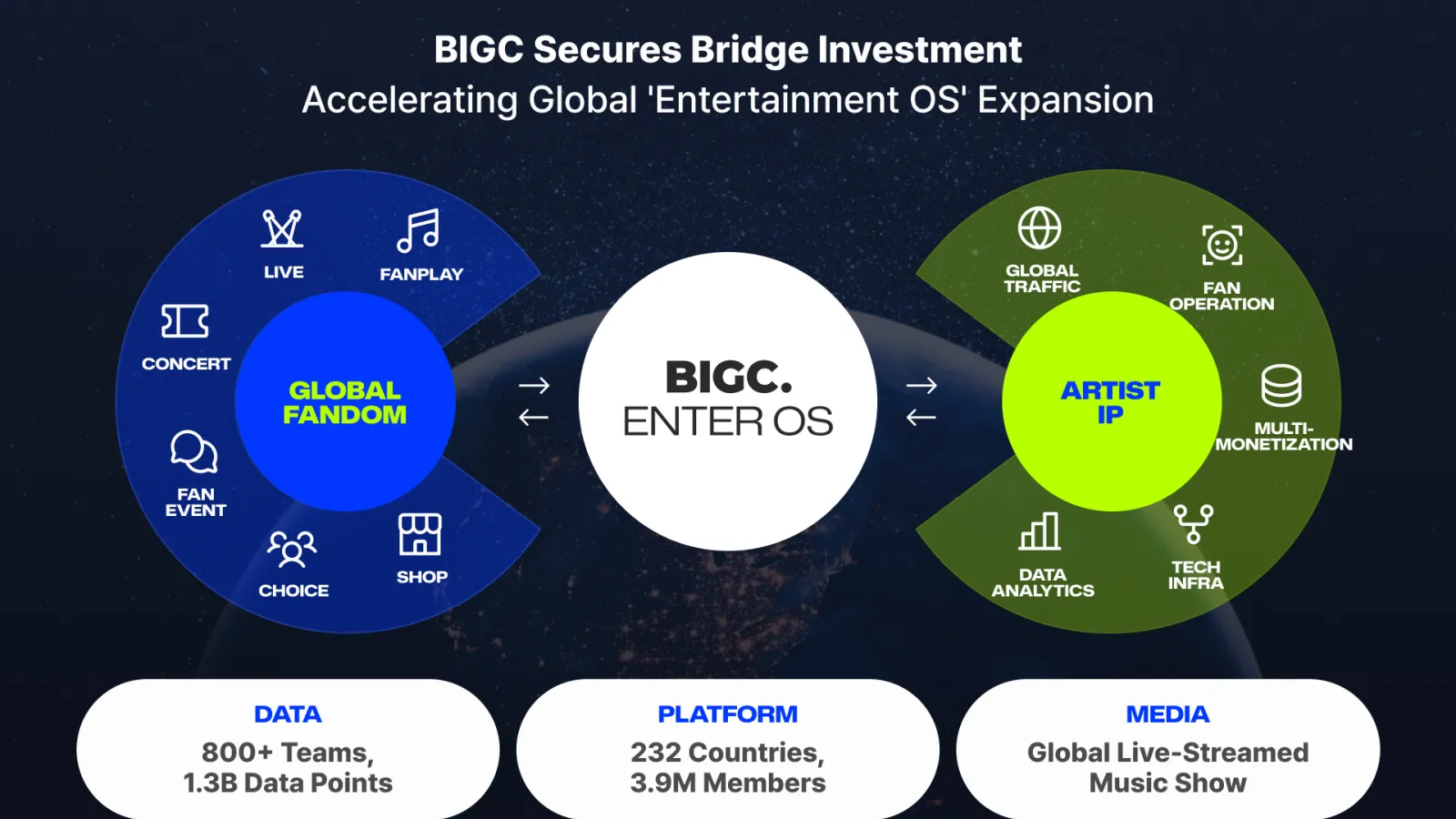
BIGC, a Seoul-based entertainment technology company, has closed a bridge investment from Daesung Private Equity and Now IB Capital, the company announced on 7 October 2026. The round, completed on 18 September, follows BIGC's Series A and is intended to accelerate development of what the company calls an "Entertainment OS": an AI-driven platform that aggregates ticketing, live streaming, merchandise commerce and fan-data analytics into a single suite for touring artists.
The company did not disclose the investment amount, post-money valuation, or the individual stakes taken by each backer.
Platform and growth metrics
BIGC operates what it describes as an All-in-One Digital Venue, targeting K-pop and K-culture artists whose world tours have historically required contracts with six or more specialist platforms. The company reports 3.9 million registered users across 232 countries and territories, with international users making up 74% of total membership and an 81% repurchase rate among users who have completed at least one transaction.
Revenue has reportedly more than doubled year-on-year for three consecutive years. The company recorded KRW 11.2 billion (roughly £6.3 million at current rates) in revenue last year, a 158% increase on the prior year. World-tour management contracts, which bundle ticketing, streaming and commerce, now account for 75% of total revenue, shifting the business from event-by-event streaming deals toward longer-duration B2B arrangements.
On the technical side, BIGC says it has reduced live-streaming latency to approximately 0.5 seconds using ultra-low-latency real-time communication technology. The company also reports that AI-based predictive traffic management allowed it to handle peak loads of 3 million concurrent users per second during a major awards ceremony vote, while cutting server costs by 90%.
To underpin its OS ambitions, BIGC acquired K-pop Radar and its associated fandom community blip in the first half of 2026. K-pop Radar holds what the company describes as 1.3 billion fandom data points, which BIGC intends to use for demand forecasting: predicting optimal concert cities and revenue opportunities for artists. The company has also secured an exclusive Korean distribution agreement with Universal Music Korea, extending its platform reach beyond the K-pop genre to broader global pop catalogues.
Chief executive Mihee Kim said: "Based on the technologies and data we have validated through K-pop, we will expand to global artists and IPs and create a new AX model for the entertainment industry."
Market context and competitive positioning
The entertainment technology stack for live events has attracted significant investment in recent years, with incumbents such as Ticketmaster parent Live Nation, as well as a range of streaming and fan-engagement specialists, competing to own the artist-to-fan data relationship. BIGC's integration pitch is not unique in concept: several well-funded platforms are pursuing similar consolidation plays in the fan-experience and creator-monetisation space. The company's differentiation, as positioned in the release, rests on the density of its K-pop fandom data and the end-to-end contract model that ties revenue to entire world tours rather than individual events.
The Universal Music Korea distribution deal is a meaningful signal for investors: if BIGC can demonstrate that its data and tech stack translates from K-pop to Western pop catalogues, the total addressable market expands considerably. However, the company has not yet named a major non-Korean artist on the platform, and the "Entertainment OS" framing remains largely aspirational at this stage.
From a regulatory standpoint, a platform accumulating 1.3 billion fandom data points across 232 jurisdictions will face increasing scrutiny under GDPR in Europe, South Korea's Personal Information Protection Act, and a patchwork of data-localisation requirements in markets such as Brazil and India. Investors and enterprise partners will want clarity on data governance architecture before the platform scales further into regulated markets.