
LiveU LU900Q delivers Tour de France live feeds via 4G/5G
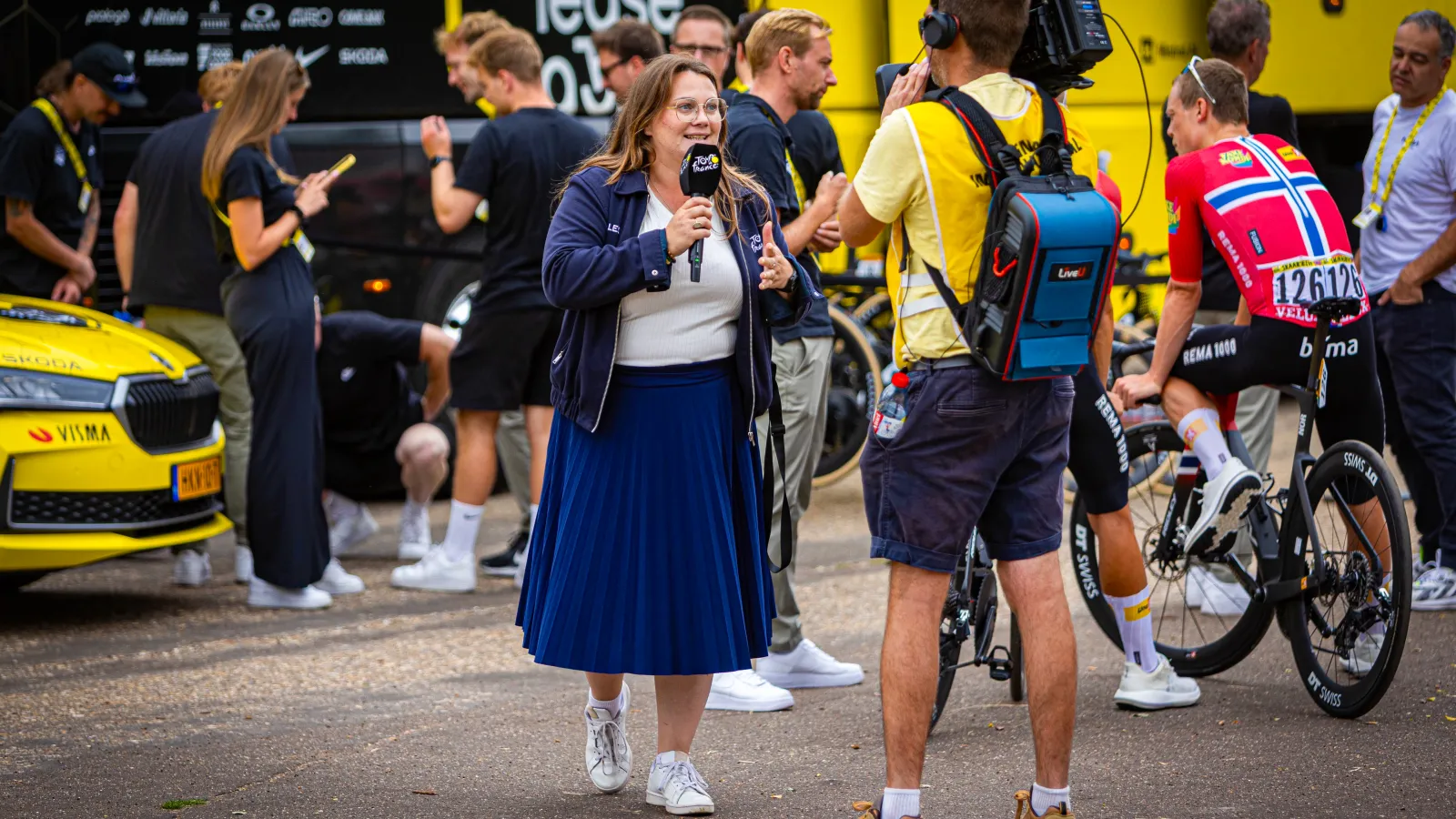
LiveU has confirmed that French broadcast services company CRD Audiovisuel deployed its LU900Q intelligent production unit, paired with the LIQ AI-driven connectivity software, to deliver live coverage from the stage starts of both the 2026 men's and women's Tour de France. The deployment marks the first time the race organiser's pre-stage programming extended beyond the daily rider presentation to include paddock footage, interviews with sporting directors, behind-the-scenes access to mechanics, and public interactions.
CRD Audiovisuel's managing director Stéphane Reibre took on the project in early 2026 with no opportunity for on-site testing in advance. The technical challenges were considerable: stage-start locations typically offer fewer network connections than stage finishes, while large media operations and spectator crowds routinely saturate available bandwidth. Previous production attempts had stalled on exactly those constraints.
The technical approach
The LU900Q uses multi-modem architecture combined with eSIM technology and LiveU's LIQ software, which the company describes as an AI-driven layer that selects the strongest available network dynamically based on each unit's location. CRD Audiovisuel ran the entire workflow on public 4G/5G networks, with no private or priority 5G allocation. LiveU says the unit covered 99.9% of connectivity needs across both races without a reported drop.
"I could never have imagined that LU900Q and LIQ would perform so well in the field," said Reibre. "We had exactly zero problems, which, in this specific context, is a small miracle. If you've ever covered a Tour, you know what I mean."
The setup was designed to be plug-and-play, avoiding the heavy RF infrastructure that broadcast engineers traditionally deploy at large outdoor events, and to impose minimal additional burden on production crews. The output was intended for direct use by broadcasters and rights holders across multiple platforms.
Market context
Bonded-cellular and IP-video transmission for live sports production has grown significantly over the past decade, driven by broadcasters seeking to cut satellite and fibre costs and to deploy reporters in locations where fixed infrastructure is impractical. LiveU competes in this space with Dejero, TVU Networks, and a handful of regional specialists, all of which offer multi-network aggregation hardware paired with managed transport protocols.
The shift from satellite to IP-based contribution is well under way at major rights holders, accelerated partly by the move to cloud-based production workflows and partly by the improved reliability of commercial 5G networks in urban environments. Congested event venues remain the hardest test case, which is what makes a Tour de France stage start a credible proof point for the category. Whether 99.9% uptime holds across a full season of varied events, and in markets where 5G density is lower than in western Europe, is the question buyers will ask before committing to an all-IP, no-private-network strategy.
LiveU says it serves more than 5,000 customers across 150 countries and also operates Actus Digital, a broadcast monitoring and compliance logging platform. The company plans to demonstrate its wider IP-video portfolio at SATIS Expo in Paris on 4-5 November 2026.