
ABB launches Intelleqt motor with factory-integrated edge intelligence
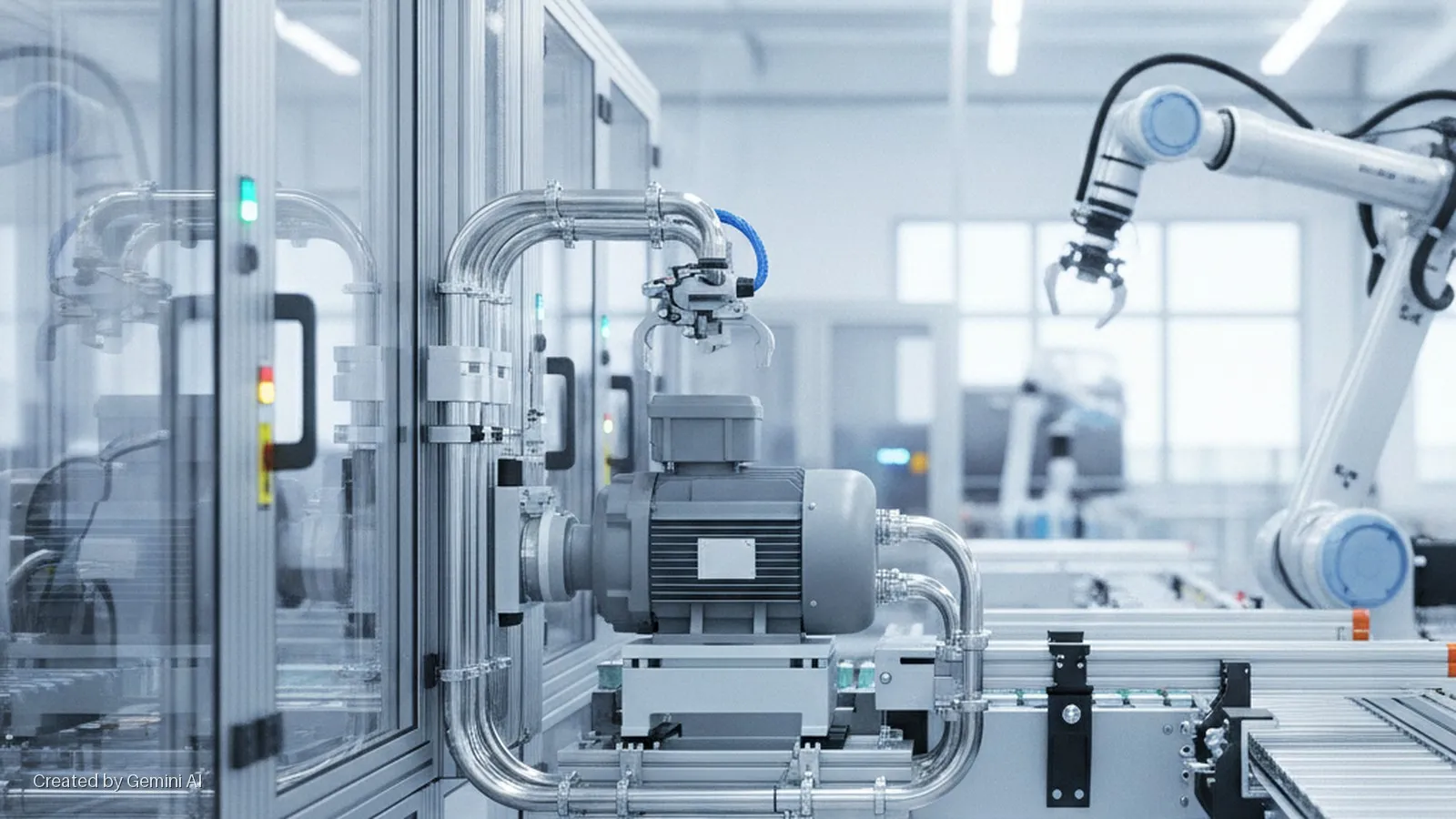
ABB has unveiled Intelleqt, a low-voltage electric motor the Swiss engineering group describes as the first to ship with intelligence integrated at the factory. Launched at the SPS trade fair in Nuremberg on 24 November 2026, the product combines on-device sensing, edge computing and connectivity to generate operational data from the moment of first rotation, without requiring a separate retrofit kit or third-party instrumentation.
The company says Intelleqt's open architecture allows motor data to feed into existing industrial platforms while keeping data ownership with the customer. The launch marks the start of a co-creation phase with original equipment manufacturers and end users, with a wider commercial rollout targeting Europe, Japan, China and India planned for 2027.
The technology and the numbers
ABB anchors the commercial case on a cluster of third-party-sourced figures. Early fault detection, the company says, can cut unplanned downtime by up to 50 percent, citing McKinsey research on predictive maintenance at scale. It pegs the cost of a single critical motor failure at up to $1.5 million per incident, a figure derived from an assumed 12-hour outage of a 110 kW motor at a global median downtime cost. The company also cites International Energy Agency data suggesting energy management practices can unlock savings of 30 percent or more for motor-driven systems.
The scale of the opportunity is significant on paper. More than 300 million motor-driven systems operate globally, according to the IEA, accounting for roughly 60 percent of industrial electricity demand. The global market for IEC and NEMA low-voltage motors is valued by ABB at $18 billion, with the company positioning Intelleqt to capture a share of that base as industrial AI adoption accelerates.
Stefan Floeck, President of ABB's IEC Low Voltage Motors division, said: "Most of the motors powering global industry do not generate data and remain invisible to the intelligence being built around them. ABB Intelleqt opens a new chapter in motor development, transforming motors from mechanical equipment into sources of real-time intelligence."
ABB said it spent $1.3 billion on R&D in 2025, targeting 4.5 to 5.0 percent of group revenues in future years, and has grown total R&D investment by around 30 percent since 2022.
Market context and competitive read-across
The industrial IoT and predictive-maintenance market is well-populated. Siemens, Rockwell Automation, Schneider Electric and a range of specialist sensor vendors already sell condition-monitoring overlays for rotating equipment, typically as hardware add-ons or cloud-connected retrofit modules. ABB's differentiator, as presented here, is factory integration: intelligence shipped as part of the motor rather than bolted on afterwards, lowering the deployment friction for plant operators who have historically resisted IIoT rollouts because of integration complexity.
The Deloitte statistic cited in ABB's release, that 84 percent of manufacturers report AI benefits but only 20 percent of use cases have successfully scaled, reflects a widely observed pattern in industrial digitalisation. Equipment-level data scarcity is a genuine constraint, and the argument that motors are an underused data source is credible. Whether Intelleqt's edge compute capability is sufficient to run meaningful inference locally, or whether it primarily acts as a data-collection and telemetry layer feeding cloud or on-premises models, is not clarified in the release.
From a standards and regulatory perspective, the 2027 rollout in Europe will intersect with the EU's Energy Efficiency Directive and the ongoing revision of motor efficiency tier requirements under IE-class regulations. Data generated by Intelleqt and transmitted off-device will also need to satisfy GDPR and, in industrial contexts, the EU's Data Act, which came into force in September 2025 and establishes rules on access to data generated by connected products. ABB's stated commitment to customer data ownership is consistent with the Data Act's default position, but buyers will want contractual clarity on data portability and secondary-use restrictions before committing at scale.