
Budgyt targets nonprofit Excel holdouts with FP&A platform pitch
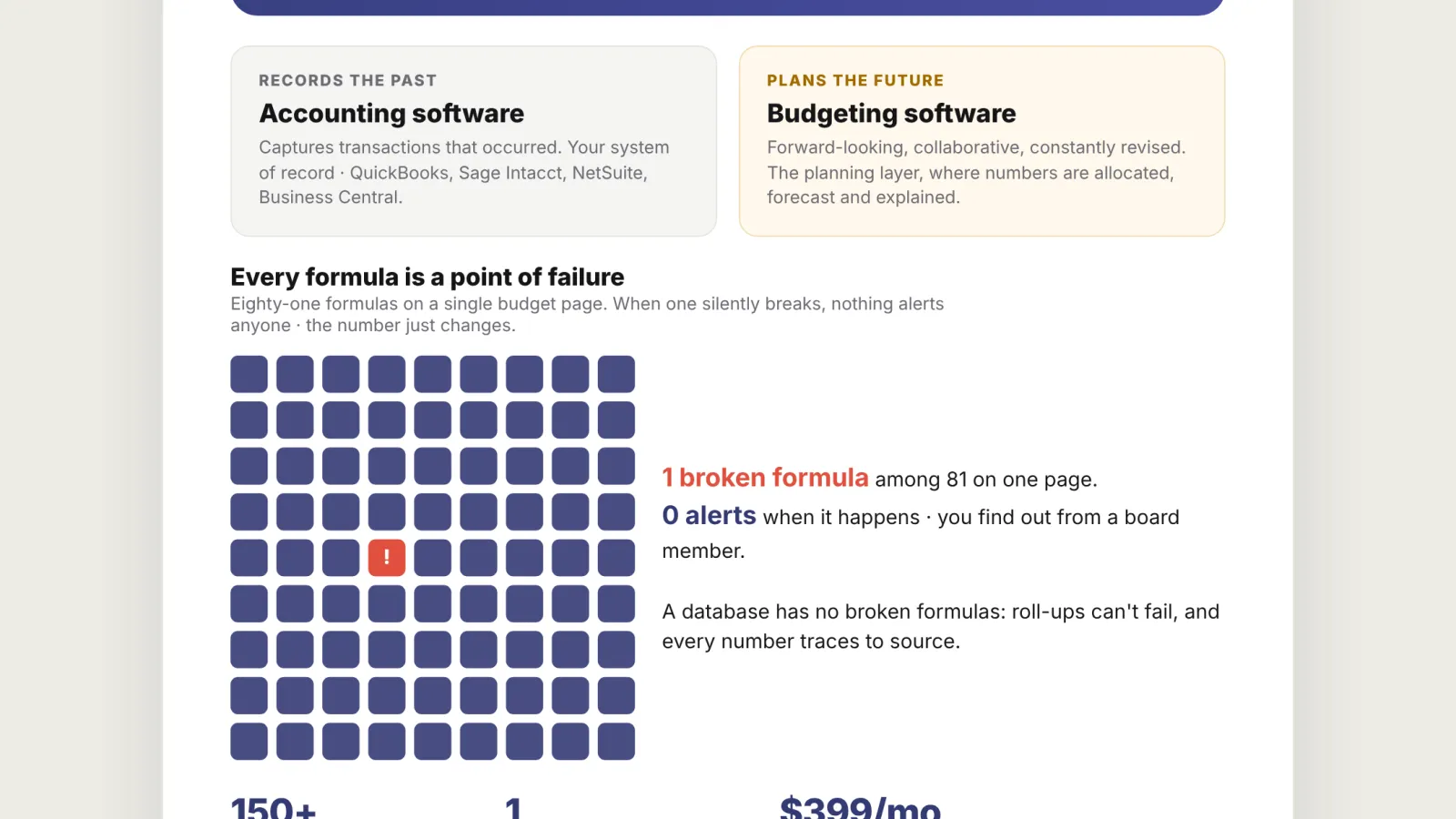
Budgyt, a New York-based financial planning and analysis platform focused on the nonprofit sector, has published a position piece arguing that spreadsheets are structurally unfit for organisational budgeting, and that the distinction between budgeting and accounting software is one many finance teams blur to their cost. The company says its platform is now used by more than 800 organisations and 4,000-plus users across 13 years of operation.
The argument at the core of the release is architectural. Accounting systems such as QuickBooks, Sage Intacct, NetSuite and Microsoft Dynamics 365 Business Central record transactions that have already occurred and act as the system of record. Budgeting, Budgyt contends, is a forward-looking, collaborative discipline that demands a different kind of tool. The company says a spreadsheet used as the planning layer between these two functions is the point where nonprofit finance processes most commonly break down.
The formula-failure problem
The release details a specific failure mode that will be familiar to anyone who has maintained a large workbook: a nonprofit budget can carry 150 accounts across a dozen departments, supported by thousands of roll-up formulas. When a formula breaks, a spreadsheet gives no alert. The number simply changes, and the discrepancy may not surface until a board meeting. The company cites one finance team's workbook containing 81 formulas on a single page.
Version control compounds the risk. When budget files are emailed to departments and then manually recombined, an organisation can accumulate dozens of slightly divergent copies. Each manual merge is a further opportunity for a figure to drift.
Budgyt's response is to replace the spreadsheet layer with a database-driven model in which roll-up formulas cannot silently break, every figure traces back to its source, and all departments contribute to a single shared model rather than separate files. The general ledger stays authoritative for historical transactions; planning, variance analysis and board reporting move into what the company describes as a purpose-built environment.
The release cites the League of California Cities as a named customer. The association, which represents the state's 483 cities, reports cutting a month from its annual budget-approval cycle between its first and second years on the platform, and reducing time spent on detailed variance analysis by 30 to 40 per cent.
Market context and competitive positioning
The nonprofit FP&A software category sits between two well-established poles. Enterprise financial-planning suites from vendors including Vena, Jirav, Datarails, Adaptive Planning and Anaplan typically carry entry-level costs from around $25,000 per year and require implementation cycles of three to six months, pricing most nonprofit finance offices out of the category. At the other end, spreadsheet workflows carry no licence cost but impose the operational risks Budgyt describes.
Budgyt positions itself at $399 per month with unlimited users, priced by department rather than per seat, and claims an onboarding timeline of roughly two weeks. The company says it is most commonly compared with Martus among nonprofit-focused tools. It holds a 4.8 out of 5 rating on G2 across 103 reviews and 4.9 out of 5 on Capterra across 68 reviews, though those figures come from self-reported user platforms rather than independently audited benchmarks.
The broader nonprofit software market is subject to light-touch regulation but is increasingly influenced by FASB accounting standards and guidance from bodies such as the National Council of Nonprofits, which frames budgeting as an ongoing management discipline rather than an annual accounting task. Finance leaders at larger nonprofit entities are also beginning to encounter audit and grant-compliance requirements that make version-controlled, traceable budget records a practical necessity rather than a preference.
James McCoy, founder and chief executive of Budgyt, put it plainly: "A spreadsheet quietly takes that control away when a formula breaks and no one is told. A database gives it back."
The company offers a free pilot programme in which it rebuilds a prospective customer's existing budget inside the platform before any commercial commitment is made.