
ICON raises $200m Series D to scale robotic construction systems
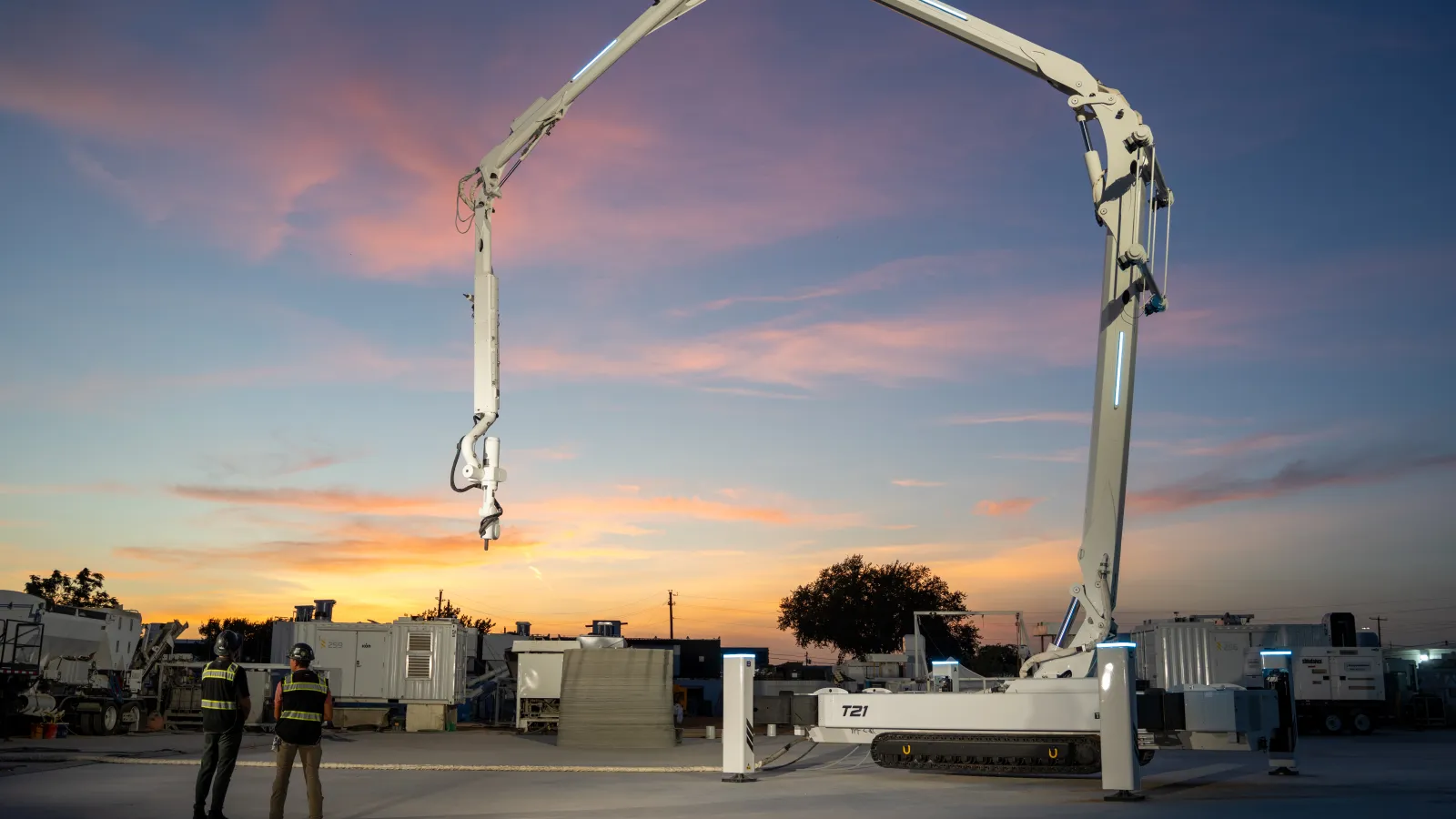
ICON, the Austin-based construction robotics company, has closed a $200 million Series D financing round co-led by Baillie Gifford and funds managed by BlackRock. Additional participants include Capital Factory, Tiger Global, Norwest, Moonshots Capital and Moderne Ventures, among others. The company says the capital will fund manufacturing of its Titan robotic construction system, open a large-scale R&D facility in Austin, and accelerate expansion across Texas, Florida, Washington D.C., and new US markets.
Co-founder and chief executive Jason Ballard said ICON had moved "from potential into proven reality," citing more than 270 homes and structures built across five states and two countries, 4x projected revenue growth in 2026, and over $370 million in government contracts secured through its Prime defence and space division. The company broke ground in January 2026 on ten barracks at Fort Bliss, which it describes as the largest deployment of robotic construction technology in Department of War history.
The technology
Titan is positioned by ICON as a multi-storey robotic construction system capable of reducing average home build times by six weeks while cutting costs by 40% against the national average, according to internal modelling benchmarked against National Association of Home Builders data. The system prints using FormCrete, ICON's proprietary material, which the company says delivers walls rated for winds of 175 mph and a two-hour-plus fire rating, against 40 mph and 30 minutes respectively for conventional timber-frame construction.
ICON operates across three divisions: Build, covering residential and commercial projects; Tech, the software platform that co-ordinates its construction systems; and Prime, the defence and space unit. Under Prime, ICON is advancing Project Olympus in partnership with NASA, developing construction systems intended for lunar surface use.
Luke Ward, private companies investment manager at Baillie Gifford, said the firm is drawn to ICON because its system "works with, rather than against, the business realities that shape a project's success," adding that the Edinburgh-based asset manager is taking a long-term compounding position on the platform's market potential.
Market context
Construction is frequently cited as one of the least digitised major industries globally, with a $16 trillion annual market that has seen comparatively little productivity improvement in several decades. The US housing shortage, estimated at roughly four million units, has become a structural political issue, lending urgency to any technology that can credibly compress build times and costs. ICON's pitch directly addresses both the supply shortfall and a documented demographic squeeze: the release cites figures suggesting 41% of the current US construction workforce is expected to retire by 2031, with under-25s accounting for just 10% of workers today.
ICON is not alone in applying robotics and additive manufacturing to construction. A number of European and Asian startups are pursuing similar large-format 3D-printing approaches, and established construction-equipment manufacturers have explored automation at the site level, though none has yet demonstrated ICON's combination of defence contracting revenue and consumer homebuilding at scale. The Fort Bliss barracks project, built to Pentagon Unified Facilities Criteria, is a meaningful third-party validation that distinguishes ICON from earlier-stage competitors whose output remains largely prototype.
The company's vertical integration across robotics hardware, proprietary materials and software also mirrors a strategy seen in advanced manufacturing more broadly, where controlling the full stack is treated as both a margin and a defensibility lever. Whether that integration advantage holds as larger construction groups or industrial conglomerates enter the space will be the key question for investors as ICON moves from proving the technology to scaling it.
ICON's next disclosed milestones are the ramp of Titan manufacturing at its Austin factory, the opening of the new R&D facility, and continued expansion of its Prime defence pipeline. A public-market path has not been announced.