
YYForce deploys service robots across 772-room Singapore hotel precinct
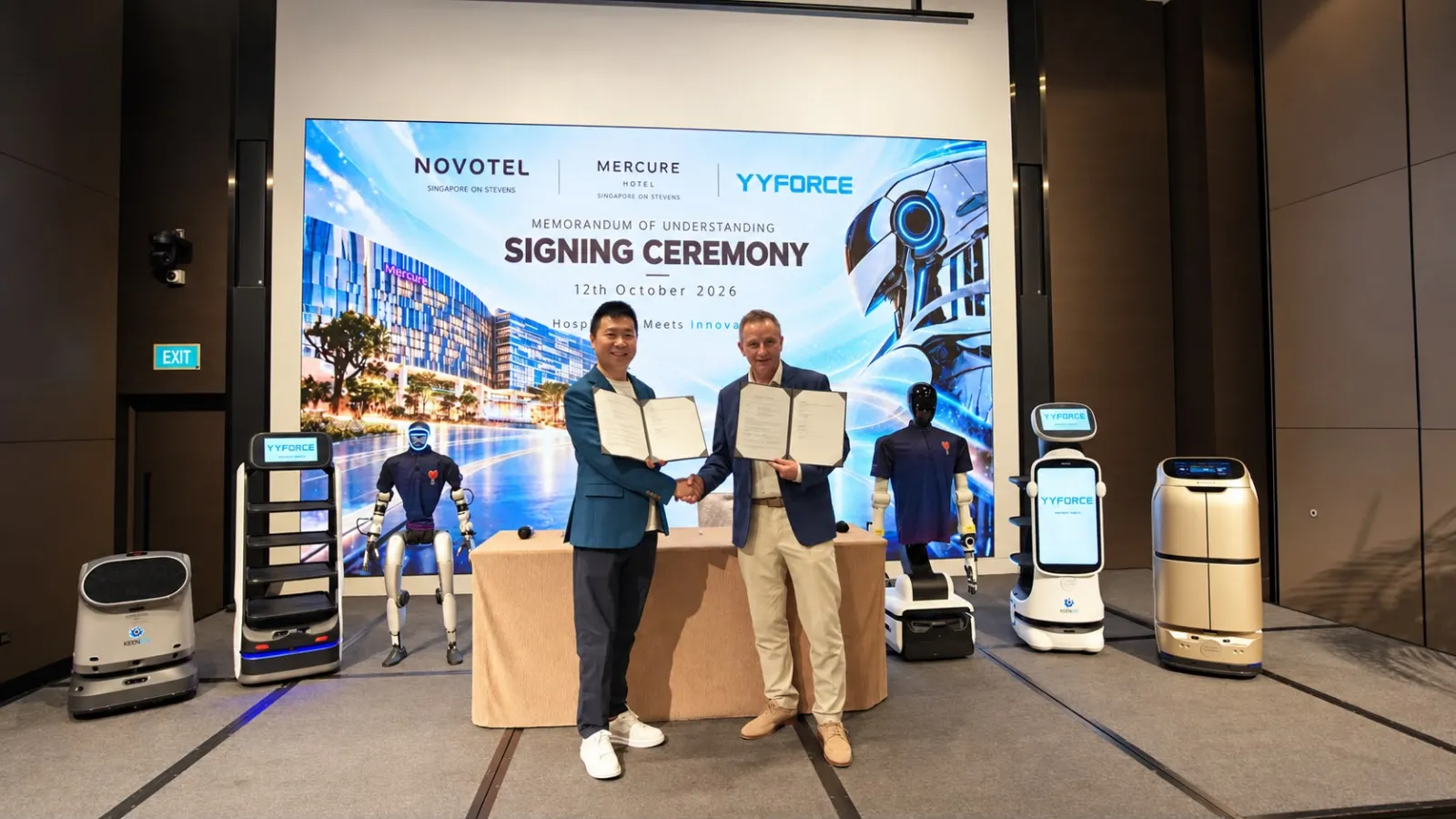
YYForce Inc. (NASDAQ: YFOR) has announced a partnership with Novotel Singapore on Stevens and Mercure Singapore on Stevens to introduce service robots across the two hotels' combined 772-room precinct. The deal, formalised under a memorandum of understanding, covers an initial rollout of specialised service robots alongside a second research phase intended to advance the company's humanoid robotics programme.
The first phase is confirmed for deployment, though preparations are still under way. Planned applications include in-room delivery of guest amenities and dining orders, food and beverage logistics across restaurants and banquet spaces, scheduled cleaning of public areas and corridors, and basic concierge support for guest directions. Lift integration, route mapping and network configuration are listed as preparatory requirements before launch. YYForce will supply hardware, software updates, maintenance and on-site technical personnel under the terms of the MOU; commercial arrangements are to follow in final agreements between the parties.
An internal pre-deployment comparison projects approximately 10% lower monthly operating costs for the selected operations covered by the model, with robot costs included. A separate planning assumption estimates a potential 5% reduction in rooms-department overtime. The company and hotels both note that these figures use different cost bases and should not be combined, and that actual outcomes will be assessed after rollout.
"In a hotel, every journey to deliver an item and every repetitive task takes time," said Piotr Kupiec, general manager of both properties. "We want to use robotics thoughtfully, so our teams can focus their attention where it matters most to the guest."
Humanoid development pipeline
The second phase is structured as an applied research programme rather than an operational deployment. YYForce intends to observe selected housekeeping and banquet workflows, with hotel staff consent and agreed data-use arrangements in place, to inform the hardware and software development of its humanoid systems. The company describes this as moving its robotics strategy beyond controlled demonstrations and into real-world service environments. Any use of guest or employee personal data would require separate review and appropriate safeguards, according to the release.
Chief executive Mike Fu said the collaboration connects technologies available for deployment today with the operational learning required to build the next generation of workforce systems, referencing the company's stated "2030 Vision" for an integrated human-AI-robotics workforce model. YYForce positions the Singapore partnership as a step toward potential applications across hospitality, facilities management and other service-intensive industries.
Market context
Singapore's hotel sector recorded average occupancy of 81.9% in 2025 and received 16.9 million international visitor arrivals, according to the Singapore Tourism Board, providing a commercially active environment in which to validate the technology. The broader hospitality robotics market has attracted growing interest from a number of vendors offering autonomous delivery and cleaning robots, including well-funded startups and established industrial automation players expanding into service environments.
Humanoid robotics for commercial settings remains an earlier-stage proposition. Several well-capitalised companies are pursuing general-purpose humanoid platforms, but few have moved beyond demonstrations into sustained operational deployments. YYForce's approach of using a live hotel environment to gather training data and refine hardware represents a pragmatic path, though the release is careful to note that humanoid systems are not yet ready to clean occupied guestrooms or operate banquets independently. Investors will likely focus on whether the first-phase service robot rollout delivers the projected cost reductions, as that outcome will underpin the credibility of the longer-term humanoid ambitions.