
ASUS ProArt P16 and P14 with NVIDIA RTX Spark now shipping in Canada
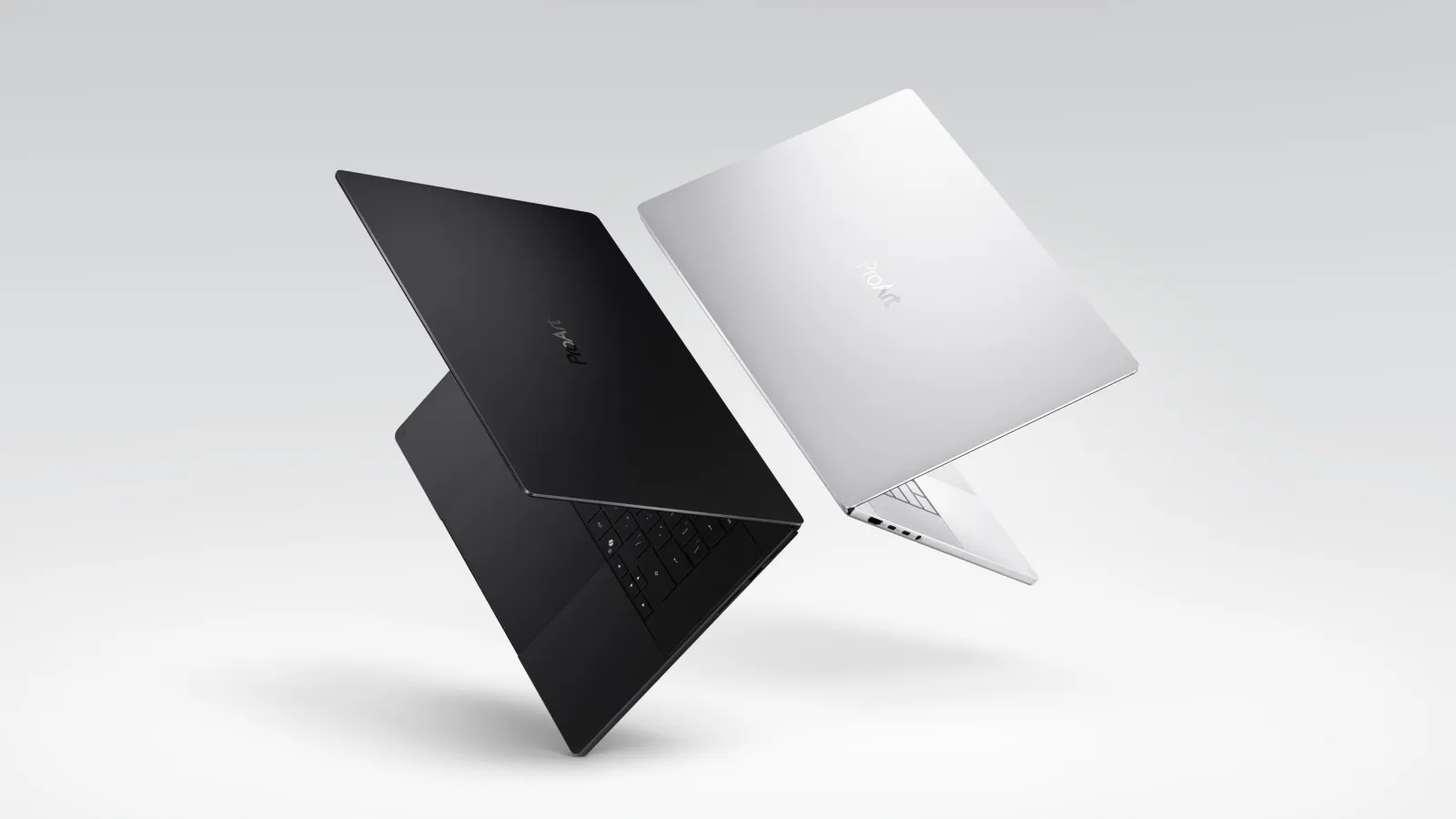
ASUS has begun shipping the ProArt P16 and ProArt P14 laptops in Canada, with units available through the ASUS Store, Amazon Canada, Best Buy Canada, Memory Express and Newegg Canada from 16 October 2026. Both machines are built around NVIDIA's RTX Spark platform, which integrates a Blackwell RTX GPU with an NVIDIA Grace CPU via NVLink-C2C interconnect technology.
The ProArt P16 starts at C$4,999 in a 32GB configuration, rising to C$9,499 for the 128GB flagship. The ProArt P14 begins at C$3,499 with 24GB of LPDDR5X memory, with a 128GB variant available at C$8,999. Both laptops ship with up to 128GB of unified memory and deliver what NVIDIA describes as up to 1 petaflop of FP4 AI performance. ASUS frames these figures as enabling users to run large language models, image and video generation pipelines, and agentic workflows locally rather than relying on cloud inference.
What RTX Spark changes for creator workflows
The core proposition is local AI execution: keeping prompts, source files and model weights on-device, avoiding per-token cloud charges and maintaining offline capability for sensitive creative projects. ASUS preloads its MuseTree application, which runs FLUX and Wan generative models locally, and StoryCube for AI-assisted media organisation.
Third-party integrations add depth to the software story. Nous Research's Hermes agent, an open-source autonomous assistant, can control desktop applications and local files with persistent memory. Dillon Rolnick, CEO of Nous Research, said ProArt RTX Spark machines provide "the memory capacity to run powerful models locally, enabling Hermes to drive ComfyUI and MuseTree, work with your files, and keep these workflows on your own machine." ComfyUI, a widely used open-source visual workflow tool, is also bundled, giving users a node-based interface for building and sharing generative pipelines. ASUS's own Zenni Claw assistant rounds out the agent ecosystem.
On the hardware side, the ProArt P16 is 12.9mm thin and weighs 1.77kg, making it the slimmest 16-inch ProArt to date. Both models feature Lumina Pro OLED panels with Delta E less than 1 colour accuracy, 120Hz refresh rates and up to 1,600 nits HDR peak brightness. Connectivity includes Wi-Fi 7, three USB4 Gen 3 Type-C ports and SD Express 7.0 (P16) or SD 4.0 (P14).
Market context and competitive positioning
The launch places ASUS squarely in the emerging local AI PC category, a segment that has gained considerable momentum as NVIDIA's Blackwell architecture rolls out across laptop form factors. The positioning targets creative professionals who handle large media assets and AI engineers running fine-tuning or inference workloads where cloud latency and recurring token costs are a genuine friction point.
Competitors in the high-memory creator laptop segment include Apple, whose M-series MacBook Pro line has long offered unified memory architectures at comparable price points, and Microsoft's Surface Studio-class devices. The differentiator ASUS is pursuing is NVIDIA's CUDA ecosystem: the vast majority of open-source AI tooling, including ComfyUI and most HuggingFace-hosted models, is optimised primarily for CUDA rather than Apple's Metal or AMD's ROCm. That software gravity gives RTX Spark machines a practical advantage for developers deploying models from the open-source ecosystem.
Privacy considerations are increasingly shaping enterprise procurement for AI-capable hardware. UK and EU organisations subject to GDPR, and those operating under sector-specific frameworks such as ISO 27001 or financial-services data-handling rules, face real constraints on sending sensitive content to cloud inference endpoints. Local AI hardware directly addresses that compliance pressure, and ASUS's positioning language reflects an awareness of this dynamic.
ASUS says additional memory configurations, including a 48GB ProArt P14 and a 64GB ProArt P16, will follow later in 2026. A complementary compact desktop, the ProArt GR1X mini PC, extends the RTX Spark portfolio to studio and small-team environments.