
iJOOZ and NUS Business School sign five-year AI retail MOU
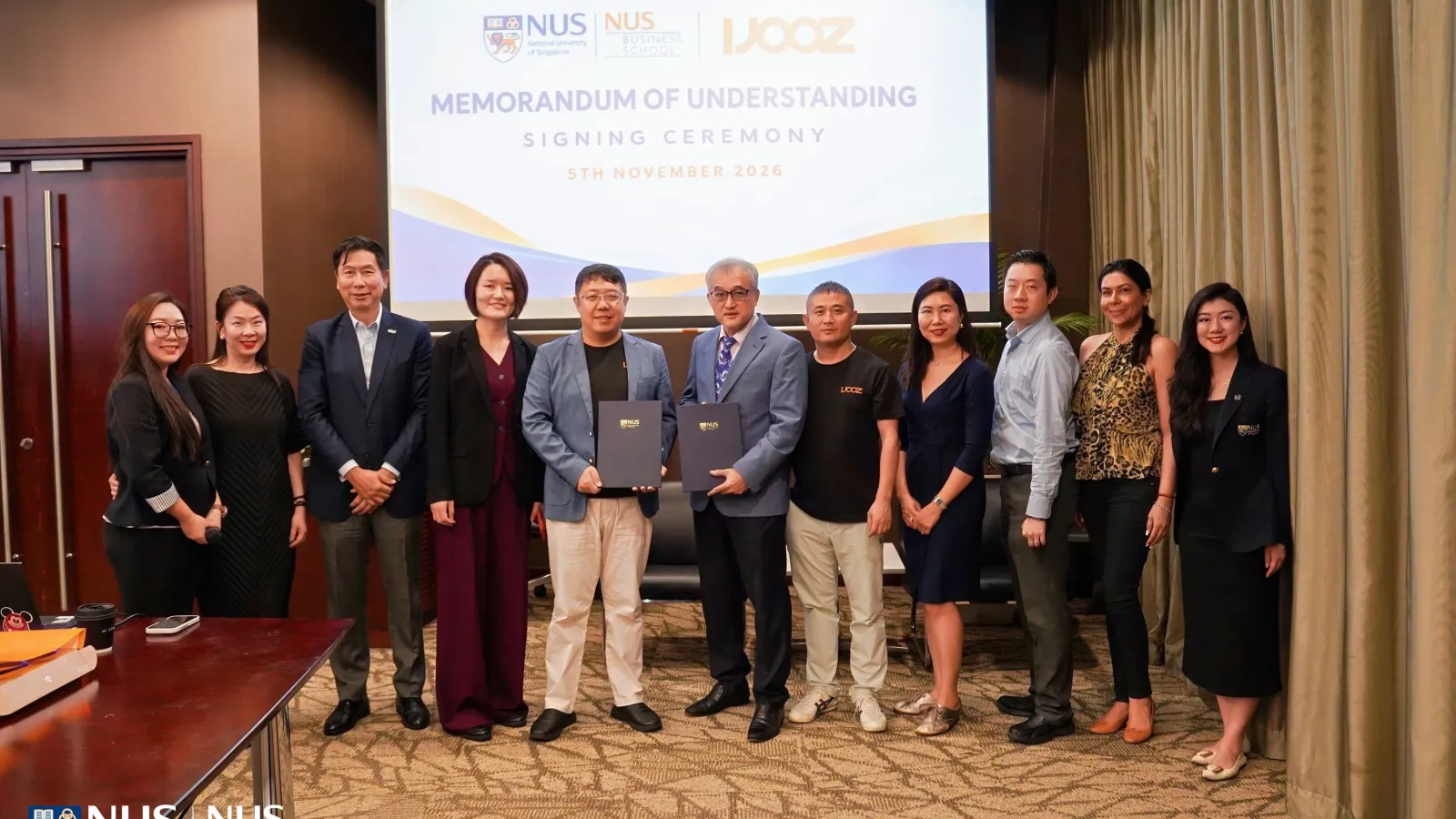
Singapore-based smart retail technology company iJOOZ AI Pte. Ltd. has signed a five-year Memorandum of Understanding with the National University of Singapore (NUS) Business School, covering applied research, business education and industry engagement. The agreement was announced on 5 November 2026 and formalised at a signing ceremony attended by iJOOZ founder Bruce Zhang and NUS Business School Dean Professor Teo Chung Piaw.
The collaboration is focused on potential applications of artificial intelligence and data analytics in retail operations, with specific areas of inquiry including consumer behaviour modelling, dynamic pricing, demand forecasting and supply-chain optimisation. iJOOZ brings a network of approximately 3,000 vending machines operating across more than 30 countries to the partnership, providing NUS researchers with real-world operational data and commercialisation experience.
The partnership
Beyond research, the MOU sets out a programme of experiential learning for NUS Business School students, including case studies, consulting projects and workshops. iJOOZ's international expansion story, from a Singapore fresh-juice vending startup founded in 2016 to a multi-country IoT-integrated retail network, is positioned by both parties as a live case study in technology-driven business transformation.
Bruce Zhang said: "Our collaboration with NUS Business School is an opportunity to bring together practical industry experience and academic expertise. We hope to contribute to meaningful research, share our entrepreneurial journey with students and explore new perspectives that can support innovation in smart retail and beyond."
Zhang is also set to enrol in NUS Business School's Executive MBA (Chinese) programme in 2027, beginning with its 36th intake.
Market context
Academic-industry MOUs of this kind are common in Singapore, where government-linked institutions and universities have long co-invested in applied AI research. The city-state's Smart Nation agenda and the Economic Development Board's support for retail-tech commercialisation create a policy environment that actively encourages this type of partnership. NUS Business School has a track record of similar industry collaborations, though the commercial outputs of such agreements can vary considerably depending on the specifics of funding, IP ownership and publication rights, none of which were disclosed in this release.
The automated retail sector more broadly is attracting growing interest from AI vendors seeking to apply computer vision, reinforcement learning and predictive analytics to physical retail environments. Major technology groups including Alibaba, Amazon and a range of well-funded Asian startups are pursuing similar capabilities in adjacent categories such as cashierless checkout and autonomous stock replenishment. For a company of iJOOZ's scale, the NUS affiliation may help with talent acquisition and academic credibility as it competes for enterprise retail contracts against better-capitalised incumbents.
The five-year term of the MOU is longer than many corporate-academic agreements, though MOUs at this stage carry no binding financial commitments. Both parties will need to publish substantive research outputs or named commercial applications for the partnership to demonstrate tangible value beyond its announcement.