
STMicroelectronics unifies STM32 MCU platform across automotive and
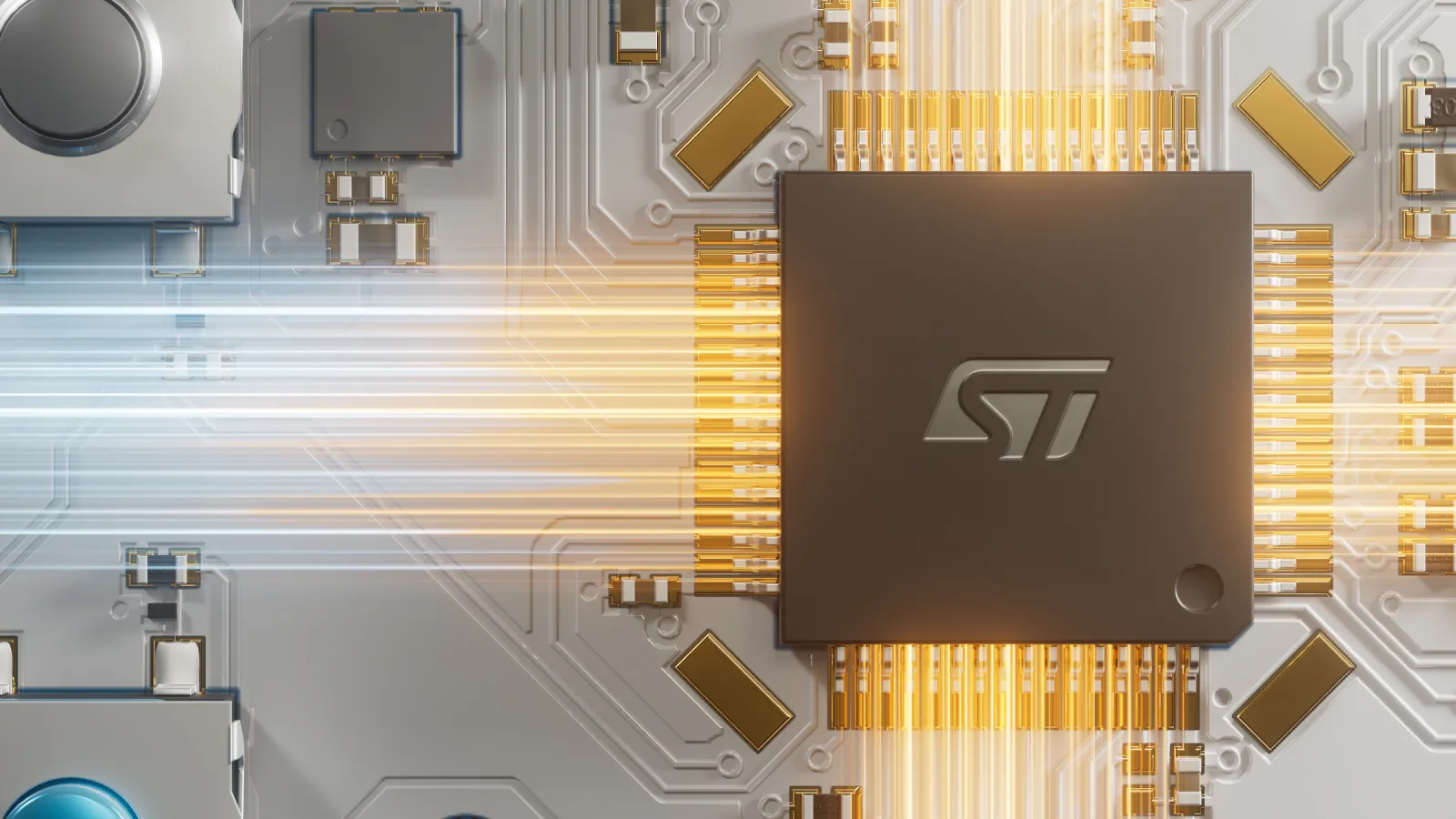
STMicroelectronics has announced a strategic unification of its STM32 microcontroller portfolio, bringing industrial, automotive and robotics product lines under a single common platform. Alongside the architecture shift, the company introduced the STM32A family, extending the platform into high-safety and automotive systems. The first three STM32A devices are sampling now, with broader availability scheduled for 2027.
The move is framed as a direct response to what ST describes as growing convergence between industrial and automotive embedded systems, as edge intelligence demands consistent capabilities in real-time control, functional safety, secure connectivity and on-device AI processing.
The platform
The unified STM32 architecture rests on Arm Cortex-M cores across all families, giving development teams a common software and intellectual property foundation. ST's STM32Cube software ecosystem, which the company describes as the world's largest MCU software ecosystem, provides a consistent toolchain regardless of target application domain. Shared process technologies underpin the roadmap: ST's existing 40nm Flash and 18nm FD-SOI nodes, supplemented by TSMC embedded non-volatile memory technology, give the company a scalable manufacturing base for future derivatives.
Three initial STM32A devices define the automotive and safety tier. The STM32A4 addresses entry-level automotive local-control nodes; the STM32A5 covers mid-range safety-critical roles in industrial automation, robotics and energy systems as well as automotive; and the STM32A9 targets safety-critical multi-domain control applications where low-latency Ethernet and deterministic communication are requirements.
Remi El-Ouazzane, President of ST's Microcontrollers, Digital ICs and RF Products Group, said: "Embedded innovation should not require developers to start again with every new product. With the unified STM32 platform, we are creating a foundation they can trust across markets and generations."
Arm is named as a lead collaboration partner in the initiative. Drew Henry, Arm's Executive Vice President for Physical AI, said the two companies are advancing the Cortex-M architecture together "to meet the demands of intelligence at the edge, where the physical world is sensed and controlled."
Market context
The MCU market has been undergoing a structural shift as AI inferencing workloads migrate from cloud to edge, creating demand for microcontrollers that can handle sensor fusion, motor control and lightweight neural-network inference within tight power and cost budgets. ST is not alone in pursuing platform consolidation: NXP's S32 architecture similarly targets a cross-domain automotive and industrial footprint, while Renesas has pursued the same logic through its RA and RH850 families. Infineon's AURIX line holds a strong position in automotive safety applications.
A unified platform strategy carries a clear commercial rationale. Development teams that standardise on one architecture reduce re-training costs and can carry certified software stacks across product generations, lowering the barrier to qualification under standards such as ISO 26262 for automotive functional safety and IEC 61508 for industrial systems. For ST, with more than 200,000 active customers across the STM32 ecosystem, the switching costs embedded in that install base are a meaningful competitive moat against rival MCU vendors.
Regulatory and standards read-across
The STM32A family will need to meet automotive-grade qualification requirements, including AEC-Q100, and to support ASIL-B or ASIL-D safety integrity levels depending on the application. Industrial variants face IEC 61508 SIL certification pathways. The EU's Cyber Resilience Act, which introduces mandatory cybersecurity requirements for connected products sold into the European market, adds a further compliance layer for the connectivity-enabled members of the STM32 portfolio. ST has not disclosed which specific safety ratings the STM32A devices will carry at general availability, nor named any automotive OEM or tier-one supplier as a launch customer. Those details will be watched closely as sampling progresses through 2027.